This one’s a side quest. I’ve been chewing on psychology and philosophy more than is probably healthy, especially last thing at night, and bouncing the ramblings off Badger, my long-suffering AI mate. Between us we ended up with a list. Five things about your own mind you’ll probably live to regret not knowing.
It started as a reference note. Maybe teaching material one day. Then I read it out to some colleagues down the pub and someone said it sounded less like a lecture and more like a bedtime story. Fair point. So here it is. Same five things, dressed up for people who already know most of this and have been meaning to admit it.
For reading aloud to people who already know most of this, and have been meaning to admit it.
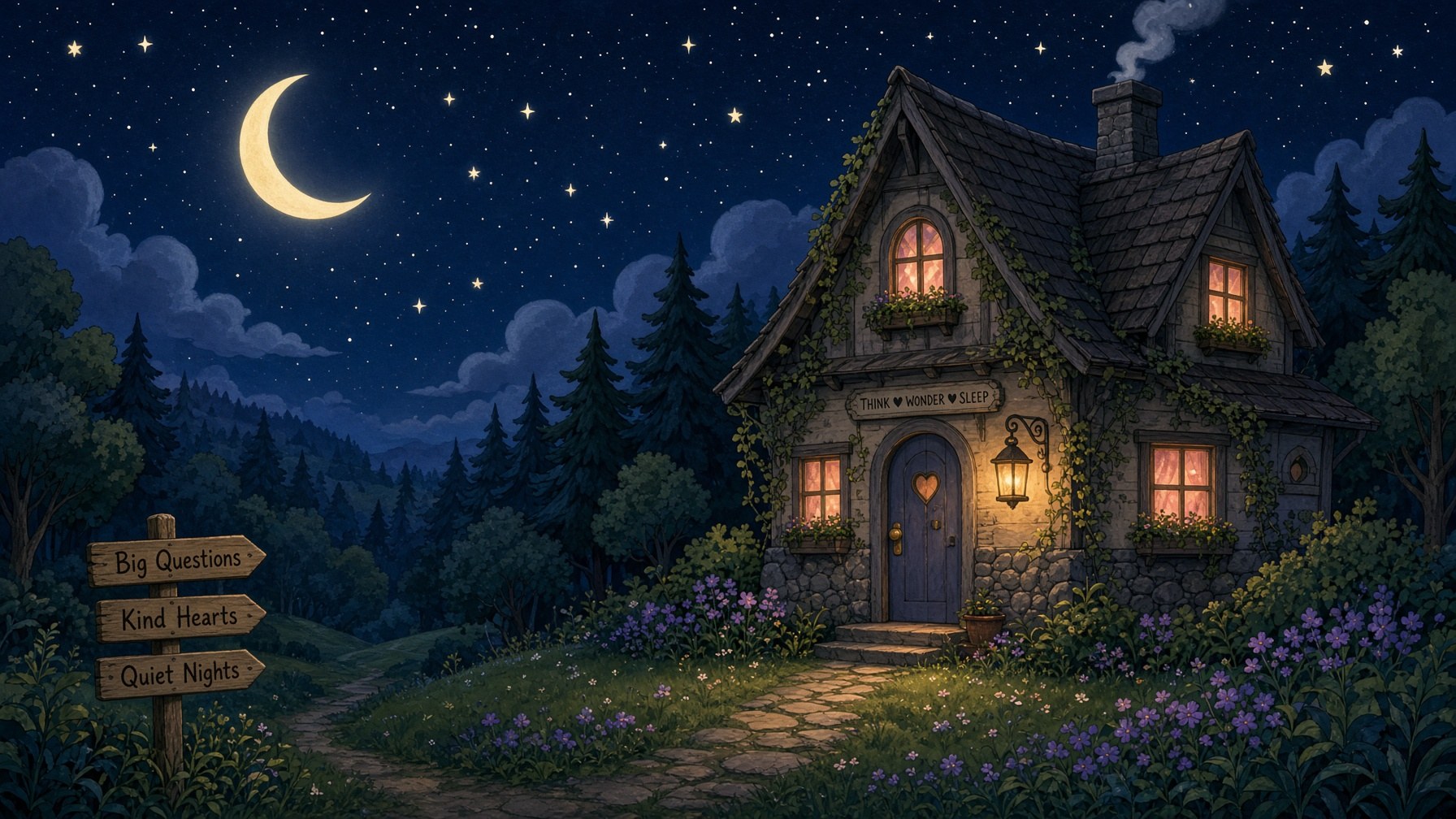
There is a house that only shows itself at dusk, and only to people who are tired in a particular way. Not sleepy, exactly. Worn thin from carrying themselves around all day. If you’re walking home and you notice a light where you’re fairly sure there was only a hedge that morning, that’s the house. You’re welcome to knock.
A traveller found it once, on an evening exactly like that. The door opened before their knuckles reached it. An old keeper stood in the gap, holding a lamp that seemed to burn a little more slowly than other lamps do.
“You can stay the night,” said the keeper. “One rule. Five rooms before sleep. You don’t have to enjoy them. You just have to walk through.”
· · ·
The first room was lined with mirrors, floor to ceiling, and the mirrors had opinions.
“You’re here because you wanted to see the house,” said the nearest one, before the traveller had properly looked at it. “Sensible. Reasonable, really.”
Nobody had asked. That was the trouble. The mirrors always answered before a question had finished forming. The answers were never unflattering. They arrived with such complete confidence that it took a while to notice the same handful of explanations kept turning up for completely different situations. Like a spokesman with one line, making it fit almost anything.
Something moved in the corner. Half in shadow. A small, dark, patient shape.
“Ask it about the third relationship,” said the mirror, quickly. “Same as the first two. Always someone else’s doing.”
“It wasn’t me,” said the traveller. Out of habit.
The shape didn’t argue. It just waited. Patterns do that. They wait to be noticed again next time.
“You don’t have to believe the shape,” said the keeper, lifting the lamp until the light finally reached the corner. “But you might stop taking the mirror’s word for it. In the whole history of this room it has never once made you look bad. Draw your own conclusions about what kind of witness that makes it.”
· · ·
The second room had weather in it. Small, local, indoor weather. It fogged over the traveller’s corner whenever they felt uncertain. Once, briefly, it thundered.
“That’s rude,” the traveller said, to nobody, as the thunder rolled close enough to prickle the back of their neck.
“It’s not rude. It’s weather,” said the keeper. “It isn’t reporting what happened. It’s reporting what you’ve already decided happened, which is rarely the same thing. Two people can stand on this exact spot. Same silence from someone they love. One gets a light drizzle. The other gets a flood. Depends which story each of them is already telling.”
A tarnished bell hung by the window.
“What’s that for?”
“You ring it before the weather’s allowed to pass. You have to say its name out loud first. Not explain it. Not fix it. Just name it. Peculiar rule. But the weather calms faster once it’s been correctly identified. Same way a child settles quicker once someone says ‘you’re frightened’ instead of ‘stop crying’.”
Down the corridor, through a door left ajar, the traveller glimpsed another room. Every window painted shut, years before, by someone who’d decided weather generally couldn’t be trusted and it was simplest to keep it out. It smelled the way a room does when it hasn’t had air in a long time.
“That one’s the opposite mistake,” said the keeper, not unkindly. “The weather was never his enemy. It was only ever trying to tell him something. He trained himself not to hear it. Eventually he couldn’t hear much of anything. Which is a storm all of its own.”
· · ·
The third room had a lake in it. Or a door onto one. Black water. A jetty. At the end of it, someone very young, sitting quite still, arms round their knees.
“Waiting to feel ready,” said the keeper. “Some of them for years.”
“Ready for what?”
“The feeling that usually shows up after you jump. Not before. Nearly everyone on this jetty is waiting for courage to arrive first, like a guide who’s going to walk them in. It hardly ever does. Mostly it turns up already wet, a few seconds behind you, once you’ve gone in without it.”
The traveller thought of everything they’d been meaning to start once they felt like it. Filed neatly under not yet. Each postponement reasonable on its own. Each one quietly making the water look colder than it actually was.
“What happens if they never jump?”
“Nothing dramatic. That’s the whole trick of the place. Nobody drowns on this jetty. They just get very good at standing on it. The water stays exactly as cold as the day they arrived, because you can’t get used to a temperature you’ve never let yourself feel.”
Somewhere behind them a door swung shut on its own. Gently. The way doors do when the wind changes, rather than because anyone pushed it.
· · ·
The fourth room was a ballroom. Everyone in it wore a mask. The peculiar thing about the masks was that each one showed not the wearer’s own face, but whatever expression the person standing opposite most wanted to see.
The traveller watched one dancer move from partner to partner all evening. Her mask flickering delight, agreement, wit, sympathy, whatever the moment called for. Never the same face twice. Dancing beautifully. By the last song she looked exhausted in a way that had nothing to do with dancing.
“She’s very well liked,” said the keeper.
“Is she happy?”
“Different question. She’s forgotten what’s underneath. It’s been so long since anyone asked to see it, she isn’t entirely sure it’s still there.”
Near the drinks table stood someone wearing no mask at all. Plain-faced. A little awkward. Not everybody liked him. A couple of people had drifted off mid-sentence, unimpressed. But every so often someone crossed the whole floor just to talk to him, because at least with him you knew who you were talking to.
“You need the room,” said the keeper. “That part isn’t optional. People who try going without it get strange and brittle. A plant left with no company doesn’t just miss the company. It starts growing wrong. But you don’t need every mask in it to approve of you. Those are two separate debts. Most people spend a lifetime paying off the wrong one.”
· · ·
The last room was a staircase. Just a staircase, turning upward. Under every door along the way, a warm line of light.
Happiness is up here somewhere, the traveller thought, climbing straight past the first door, certain the good one would be higher.
It never was. Every door, once tried, turned out exactly as good as the last and no better. Entirely ordinary within a week or two of imagined time. Then another flight appeared above it, promising, as they all had, that this next one was the real one.
Eventually the traveller simply stopped, halfway up. Too tired to keep climbing. Slightly embarrassed at how far they’d come on such a thin promise.
Someone was already sitting on that step. Had been a while, by the look of it. Not climbing. Not waiting for a door to prove itself. Just tending a small candle in a jar, nearly spent, feeding it carefully with what was left of an old stub. Unhurried. The way you’d do a chore you didn’t mind.
“Doesn’t it bother you,” the traveller asked, “that you’re not getting anywhere?”
“I’m not trying to get anywhere,” the man said, without looking up. “I’m keeping this lit. Completely different job. Turns out it’s the only one on this staircase that doesn’t run out on you the moment you finish it.”
· · ·
By the final door the traveller was nearly asleep on their feet, which the keeper appeared to have been counting on.
“Is this room six?”
“There isn’t a room six. It’s the same room, five times, in five different coats. The mirrors, the weather, the lake, the masks, the stairs. All the same piece of advice, wearing different furniture. Don’t take your mind’s first answer as the last word. Not because your mind’s against you. Because it’s in a hurry, and it likes tidy stories, and the tidy story is almost never the whole one.”
The bed, when they reached it, was plain and warm and exactly the size of a person.
“One more thing,” said the keeper, turning the lamp down until the room was nearly dark. “None of this mends a broken leg. Or grief that’s gone on too long. Or the kind of dark that doesn’t lift by morning. Some nights you need a doctor, not a house. This place is only for the ordinary weight of carrying yourself around. Same as everybody. It isn’t a small weight. It’s just an ordinary one.”
Then the keeper went out. The house went quiet. The wind did the thing it does to old windows. Sleep came the way it always does. Not because the traveller finally understood it, or firmly decided to have it, but because they stopped chasing it and lay still long enough to let it catch up.
Which, if the mirror room had been listening, it would have recognised at once.
The doing came first.
The feeling, faithfully, followed.