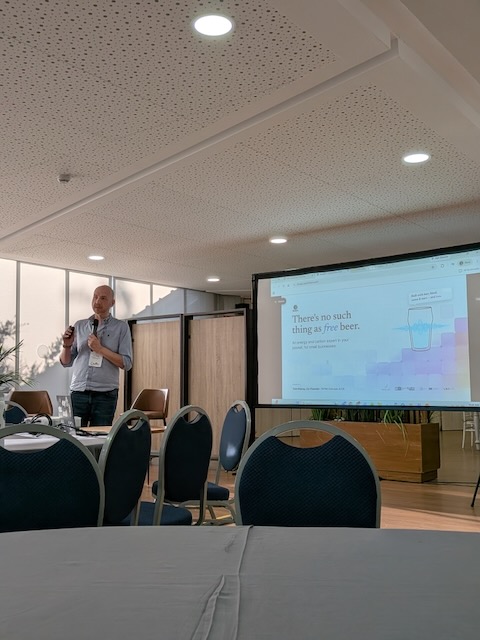
I’ve just got back from another ISPIM, and I’ll be honest, this year the divide felt sharper than ever.
On one side were the builders: practitioners shipping real things, many of them now supercharged by AI, integrating it so deeply into their thinking that their output feels orders of magnitude faster and more ambitious. On the other side ran a strong current of academic caution, focused on the risks to jobs, the concentration of power in a few large firms, and the case for regulation and careful ethical guardrails. Both threads ran through the same event, often the same rooms, and yet, I felt they rarely met. We weren’t having one conversation about innovation - we were having two.
I came home expecting (somewhat pompously) to write that one side gets it while the other watches warily from the previous page of the book. Instead I left convinced of something more uncomfortable: both camps are right about more than they realise, and they are arguing past the thing they really disagree about.
The pace problem cuts both ways
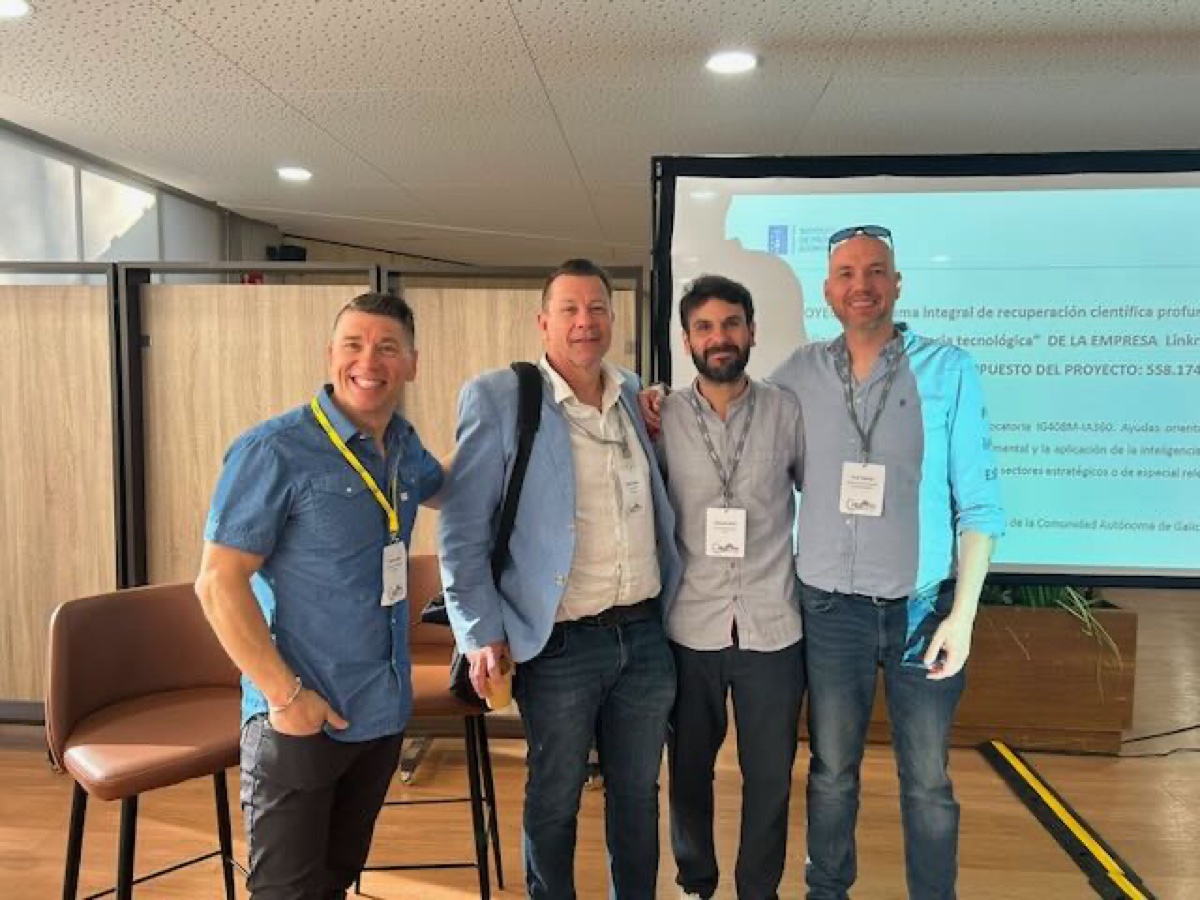
Tim Urban put it well in What’s Our Problem?. Our “monkey brains,” (the pattern-matching parts of us built for a slower world), struggle when technology moves exponentially. The usual telling of this is a gentle dig at the skeptics: keep up, the curve is real. But the monkey brain has two failure modes, not one, and both were in the room at ISPIM (Rob Dew above would criticise me for that term by the way, but you know what I mean).
When this adoption slope starts to near vertical, everyone reasons by analogy from their own recent past, and the analogies start to pull in opposite directions. The builders’ analogy is that every wave of automation eventually created new categories of work, so trust the curve. The academics’ analogy is that every concentration of a powerful new capability concentrated power and left people behind, so watch the curve. Both are true, but only partially tell the story. And the data would suggest, in the past at least, neither survives contact with a slope this steep on its own. I don’t see AI, as a technology diverting from this pattern, even though many would argue that before we were automating or increasing the power of tools and not intelligence.
It is worth being honest about history while we are here, because it essentially disciplines both sides. The cleaner industrial world we eventually got was not delivered by technology alone, nor by legislation alone. Catalytic converters arrived because emissions standards demanded them. The ozone layer is recovering because of an international treaty. Acid rain levels fell to a market mechanism that regulation invented. The recurring pattern is pragmatic coupling: policy sets an ambitious target, and technology races to meet it. That should reassure everyone. The builders, because clear targets create markets they can win. The academics, because I agree, the tools really don’t point themselves in the right direction without help.
The images that stuck with me
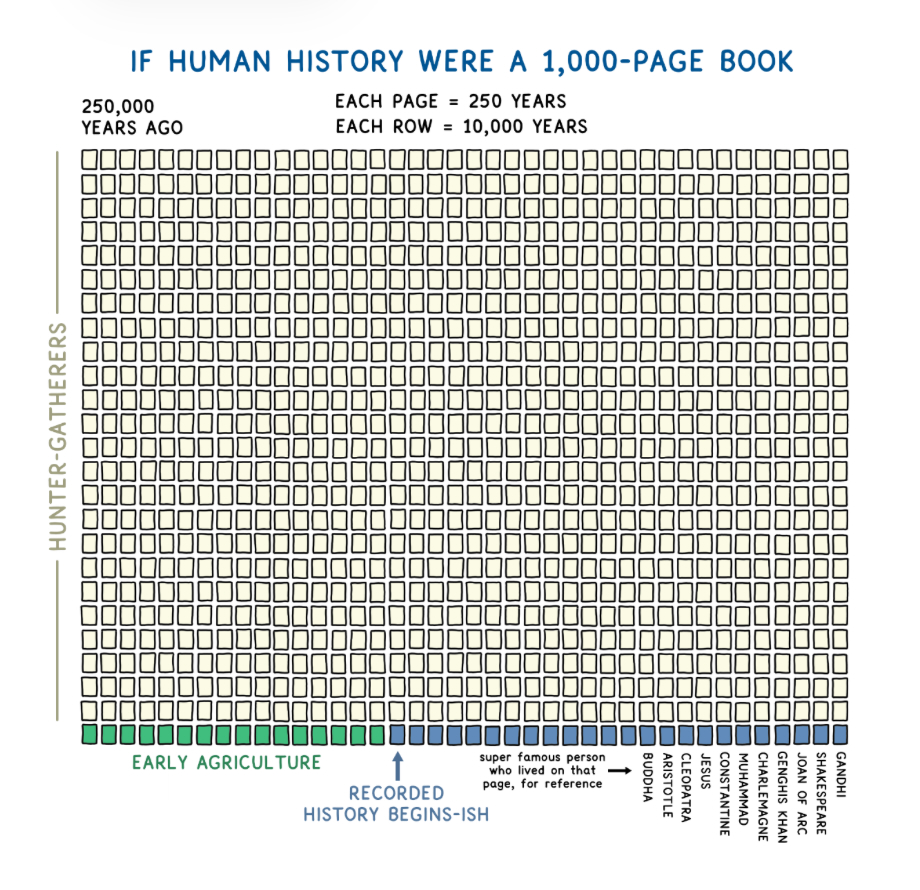
Two visuals from the week have stayed in my head. The first is the “human history as a 1,000-page book” diagram - almost all of it blank pages of hunter-gatherer existence, with recorded history crammed into the final few lines.
The second is the exponential AI curve from Wait But Why, two stick figures reacting as the AI technology (adoption) line rockets past human level, one amused, one suddenly alarmed.
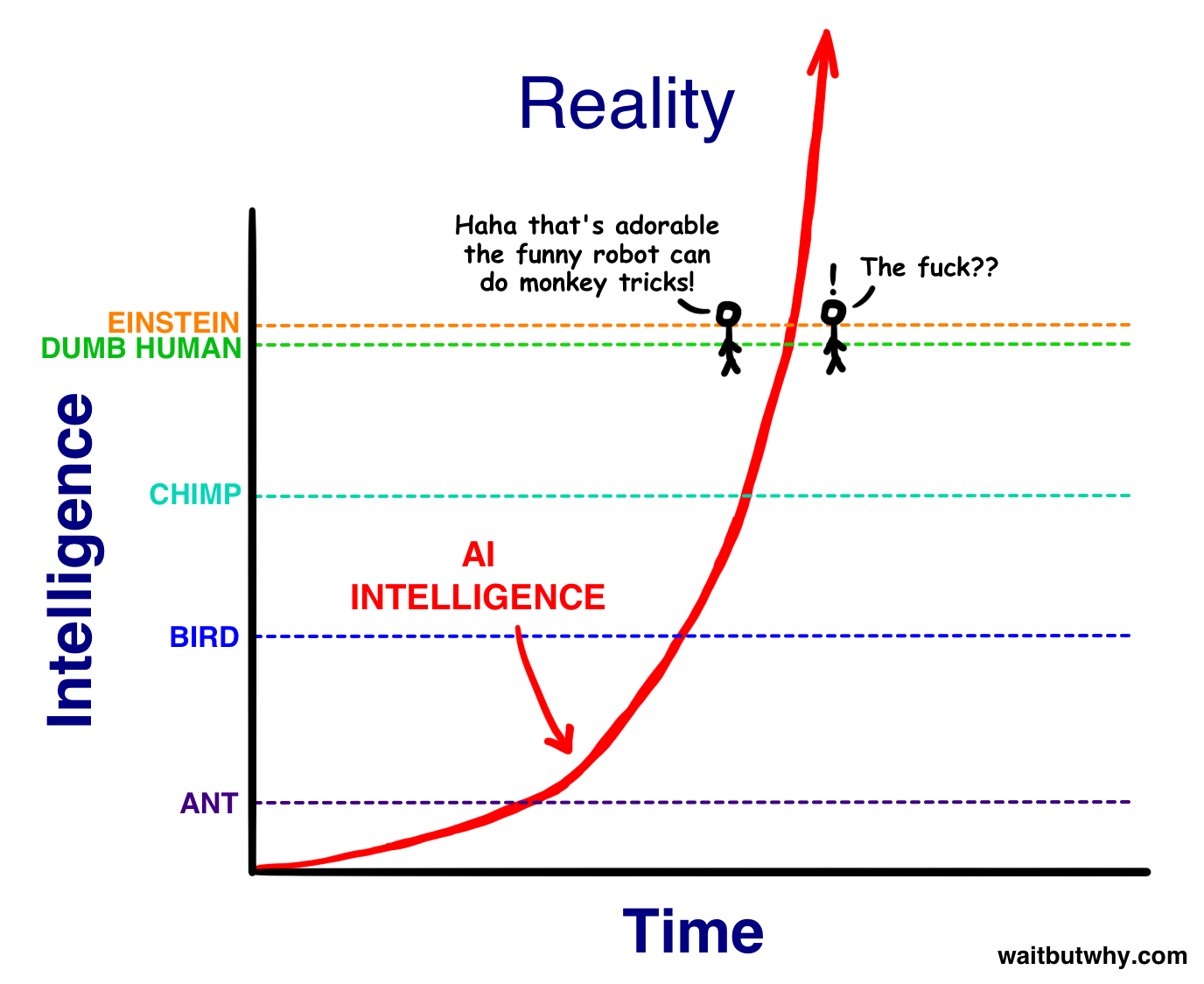
I used to read the second as a warning to the skeptics. I now think both stick figures are us. The one laughing and the one swearing are the same person a few months apart. And the builders should sit with that as much as the academics, because the conviction that “this is just the next tool” is an intuition formed on the flat part of the graph, before the line turns.
Intelligence is not the same as agency, but the question is a real one
One distinction that kept getting lost in many of these talks jars me slightly - the difference between artificial intelligence and artificial agency. I still believe conflating the two drives a lot of poor discourse. Today’s systems are designed to be helpful, and most real-world harm still runs through human intent, incentive, and emotion.
But I want to be more careful than I was before - the agentic frontier is not science fiction. The labs building the most capable systems are deliberately building toward more autonomy, not less, and questions about goals, emergent sub-goals, and systems doing things nobody quite asked for are live engineering problems at the edge of the field, which are rapidly and more apparently becoming the kind of thing that could be a real threat. So when a colleague in the audience raises agency, they are not reading from a Terminator script. They are pointing at the frontier of the work itself. And there is a tension worth realising on the builder side too: praising how profoundly these systems reshape our thinking, while insisting they are purely passive instruments, doesn’t hold. A tool that changes the operator that completely is doing something more than a hammer does. My position therefore, is not “relax, it’s only a tool.” It is closer to “it is still mostly a tool, the agency question is real and unresolved, and that is exactly why it deserves rigour rather than you waving your hands.” Cue academic analysis…
The bridge between them
Here is what changed my mind about the size of the chasm.
I had assumed the builder side simply had no language for the academics’ deepest fear, the one about power and value concentrating in a few hands. Then Satya Nadella posted a long note on the future of the firm, and it reads, to me, far less like a victory lap than like a warning.
His frame here is that every company will need to build two kinds of capital. There is human capital, the judgment, relationships and pattern recognition of its people, and there is token capital, the AI capability a firm builds and owns for itself. His claim, and I think it is the right one, is that human capital grows more valuable as the models improve, not less, because people set the direction. Or, as he puts it, “Without human direction, you have compute running in circles.”
But the centre of the piece is the fear, not the hype. He argues, bluntly, that society will not grant permission for an AI future that guts whole industries. He uses the example of the first wave of globalisation as the thing we must not repeat: the headline numbers looked healthy while entire communities were hollowed out and never recovered. His answer is to build a broad ecosystem rather than chase a single dominant model, so that value flows widely instead of pooling in a few systems that consume everything around them. This is basically how the Internet works..
Read that again with the ISPIM seating plan in mind. The power-concentration anxiety I had quietly filed under “the academics’ fear” is also the stated worry of one of the most powerful builders on the planet. He has simply attached an agentic prescription to it rather than a regulatory one.
So what are we really disagreeing about?
If almost no one serious is arguing against using these tools, then the real disagreement is not “build or don’t build.” It is about reversibility and pace. How fast do we pull humans out of decision loops? How much do we deploy before we can properly evaluate it? Can we undo a mistake once it has started to kill all humans? (Ok, I’m slipping back into Terminator here.)
That is a much more productive fight, and crucially it is one where the two camps are complementary rather than opposed. The academic instinct for second-order effects tells you where the red lines should be. The builder instinct for fast feedback tells you where those lines conflict in practice. You need both hands on the wheel, and by this I mean regulating before you know what will actually go wrong in practice holds back innovation. Better to work together and build in the abilities to act on the feedback loops, be open and transparent about processes, and build fast with that feedback at the core. This is afterall how open-source works, and there is much talk from those at the frontiers currently that the future is open-source.
My takeaway from ISPIM was that this was mostly a failure to notice we were describing the same animal from opposite ends, whilst simultaneously riding those animals off to war in opposite directions, assuming the other animal was completely the wrong choice.
What this means for the innovation community
If the divide is mostly a misunderstanding, the useful question is what bridging looks like in practice. A few things I would push for, with real jobs for both sides:
- In education and policy, scaffold on the capability rather than wall it off. Banning the tools from the classroom or the workflow only teaches people to use them badly in private. The harder, better work is building judgment on top of them. (Read my earlier blog post on this! Because I’m not a firm believer in locking and blocking, having schooled under Prof Stephen Heppell, www.heppell.net)
- Press the frontier firms for better controls and transparency, then use the ones that already exist (more open sourcing). The gap between the safety options on the shelf and the ones institutions switch on is its own quiet scandal.
- Match the response to the reversibility of the risk. Where a mistake can be caught and corrected, lean toward learning fast. Where it is irreversible, and serious, hold the hard line. This is the one that’s a headache for policy makers and I don’t think they got this right with things like ADP on iCloud in the UK.
- Take the distributional question as seriously as the productivity one. The aggregate story of automation has usually been positive, but the transition can run for a decade and fall hardest on the people with the least slack to absorb it. Studying who pays that cost is not timidity. It is precisely the second-order work that exemplifies why we have academics. Interestingly, a World Bank report indicated that the AI revolution in Africa will help them overcome longstanding barriers to economic development, as it puts incredibly powerful tools in the hands of precisely those who don’t have Western infrastructure or knowledge.
What I’m trying to build as an answer
This is not abstract for me. It is the thing I have spent the last three years building.
Nadella describes a learning loop that a company owns outright, one robust enough that you could swap a general-purpose model in and out without losing the seasoned, in-house expertise your own systems have accumulated. That is, near enough, what BrewAI is. We hold longitudinal energy and sensor data from real, operating breweries, the kind of situated, tacit knowledge no frontier model ever had and cannot commoditise, because it was never in the training set. That is token capital in his exact sense, owned by a small company rather than rented from a giant.
If the nightmare is a world where a few models capture everything and small firms find their knowledge quietly extracted from underneath them, then the answer is not to slow the models down. It is to help every small firm own its own loop. BrewAI is my attempt to prove that this is possible for an industry nobody mentions at AI conferences. It is the ecosystem Nadella is calling for, built one brewery at a time.
The page we’re on
The monkey brain will always be skeptical of exponential change. It will also be far too quick to declare each new tool harmless. Both are failure modes of the same old hardware, and pretending only the other side suffers from them is how the chasm stays open.
The people who “get it,” I have come to think, are not standing on either bank. They are the ones building the bridge: steering the acceleration while it is still steerable, owning their learning loops so the value stays distributed, and holding firm red lines on the handful of things that can never be reversed. That work needs the academic’s long lens and the builder’s fast hands at the same table, and soon, because the curve is not going to wait for us to make peace.